At Varda Space Industries, we manufacture materials in microgravity and bring them home. We fly autonomous capsules to orbit, process pharmaceuticals in the unique environment of space, and then thread the needle of a hypersonic atmospheric reentry to land the product back on Earth. As a Spacecraft Guidance, Navigation, and Control (GNC) Engineer II, I work the part of the mission where the physics is least forgiving: getting a capsule from orbit to a precise landing through a Mach 25 reentry.
The cargo itself is small but high value: each capsule carries a pharmaceutical processing payload that grows drug crystals in orbit, where the absence of convection and sedimentation can yield purer, more uniform crystal forms (polymorphs) than are achievable on the ground. Our first mission, W-1, crystallized ritonavir, an antiviral used in HIV therapy, to study how its solid form behaves in microgravity. Later W-Series flights have carried additional small-molecule drug formulations, each one processed on orbit and returned to Earth for analysis. That return is exactly the leg of the mission I own.
A Varda W-Series capsule streaking back through the atmosphere. This is the reentry environment my GNC work is built around.
Why Reentry GNC Is Hard
A Varda capsule spends weeks on orbit as a free-flying spacecraft, then has minutes to fly a ballistic, plasma-wrapped descent to a target on the ground. There is no second attempt and no go-around. Getting it right means the trajectory, the vehicle, and the navigation all have to be validated long before launch, then operated flawlessly on the day. That is the corner of the mission I own:
- Monte Carlo simulation and trajectory design optimization: characterizing landing dispersions across thousands of dispersed atmospheres, vehicle states, and deorbit conditions, then tuning the entry trajectory to keep the capsule inside its corridor and on the range.
- On-orbit GNC operations: flying the vehicle as part of the operations team, from on-orbit checkouts through the deorbit burn and reentry.
- Post-flight analysis: reconstructing what the vehicle actually did versus what we predicted, and folding those lessons back into the models for the next flight.
W-Series 4 & 5
I led Monte Carlo simulations, trajectory design optimization, post-flight analysis, and on-orbit GNC operations for W-Series 4, and post-flight analysis for the successful launch and reentry of W-Series 5. Each flight in the W-Series tightens the loop between what we manufacture on-orbit and how reliably we can return it, and every reentry is a fresh, fully instrumented dataset to sharpen the next mission’s predictions.
The team and I were on-console for the W-5 recovery, and there is nothing quite like watching a vehicle you simulated thousands of times come back exactly where the dispersions said it would.
What Reentry Looks Like
Varda has flown a growing cadence of W-Series capsules. The footage below, from the W-2 capsule’s Mach 25 return over the Koonibba Test Range in South Australia, captures the regime my GNC analysis is designed around: a small autonomous capsule trading orbital energy for heat, holding its corridor all the way down to a precise landing.
Reentering W-2: A Varda Space Industries Story
Onboard capsule view of the full W-5 reentry, from orbit to ground in a matter of minutes.
Next: Bus Block 2
Beyond flying today’s vehicles, I serve as the GNC Responsible Engineer for Bus Block 2, architecting the next generation of Varda reentry vehicles designed for multi-vehicle operations and a higher mission cadence. The goal is to make returning material from space routine: more capsules, flying more often, each one landing exactly where it should.
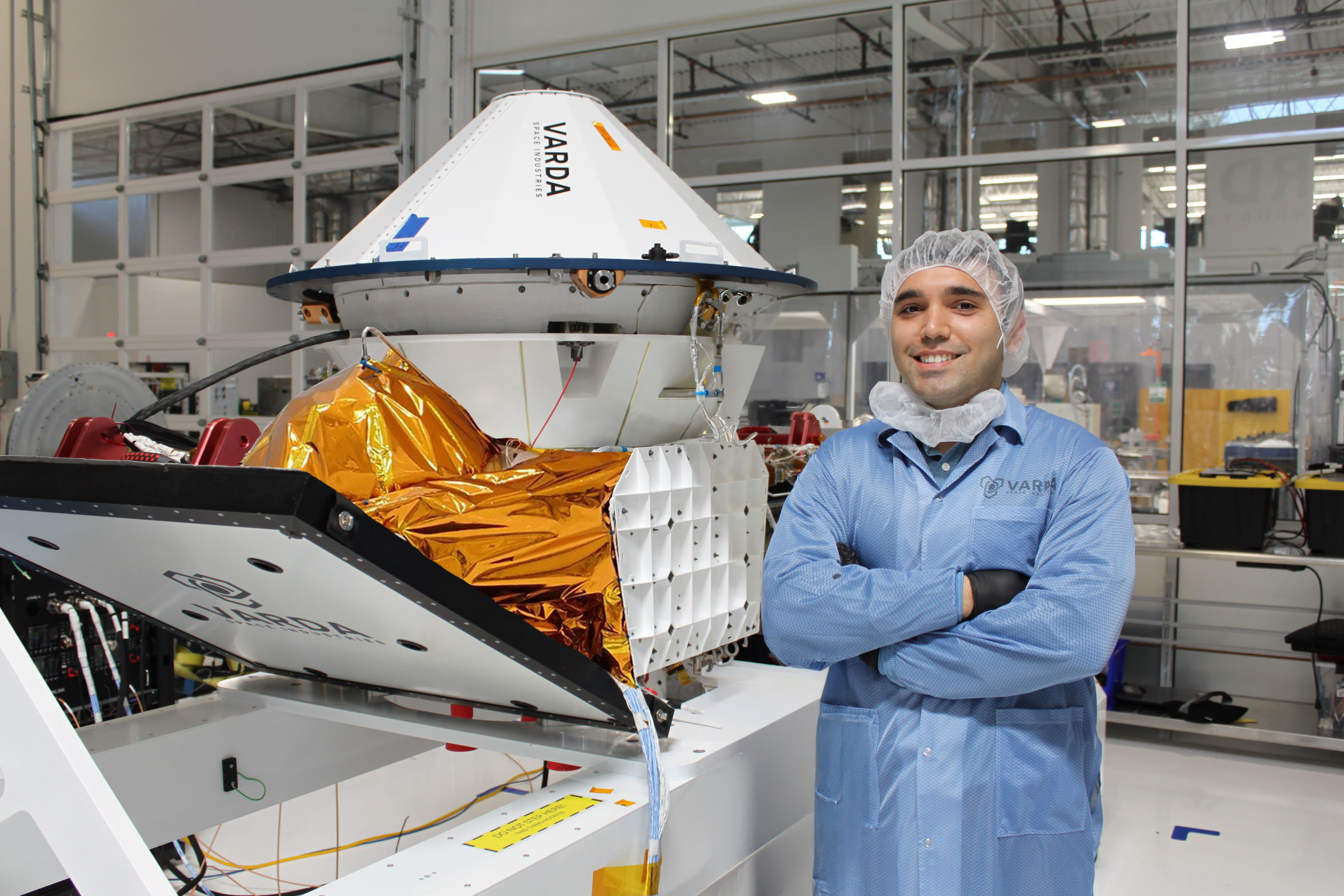
With a Varda W-Series capsule bus in the cleanroom.
In-space manufacturing only matters if you can reliably get the product back. That return, the trajectory, the dispersions, the operations, and the landing, is the problem I get to work on every day.